A Practical Sensory Panel Template for Marinated Chicken Tenderness Trials
For a poultry further-processing plant, tenderness is not an abstract sensory word. It is a commercial specification tied to bite, yield, cook performance, complaint risk, and repeatability across shifts.
When enzyme tenderizing is part of the process design, a sensory panel should do more than ask whether chicken is tender. It should separate useful tenderness improvement from soft, pasty, over-processed texture. It should also give R&D, QA, production, and procurement a shared basis for deciding whether a formulation is ready for a larger plant trial.
FibreYield supports processors looking for an enzyme supplier for poultry meat tenderizing with application guidance, validation trial structure, and scale-up support for marinated chicken systems.
Where the Sensory Panel Fits in the Validation Path
A practical tenderness validation usually has four connected stages:
- Bench screening to compare formulation concepts under controlled conditions.
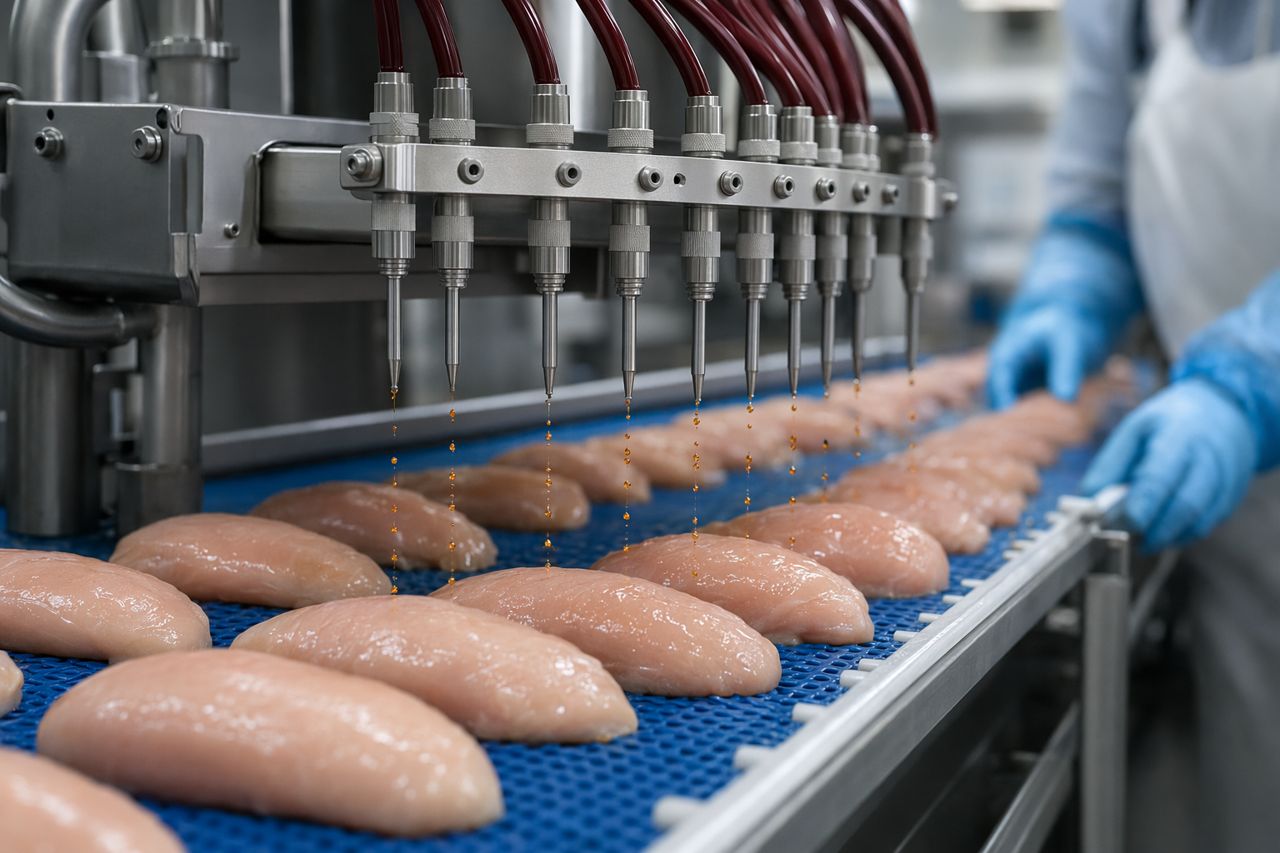
- Pilot or line-adjacent trial using plant-relevant injection, tumbling, dwell time, and cook conditions.
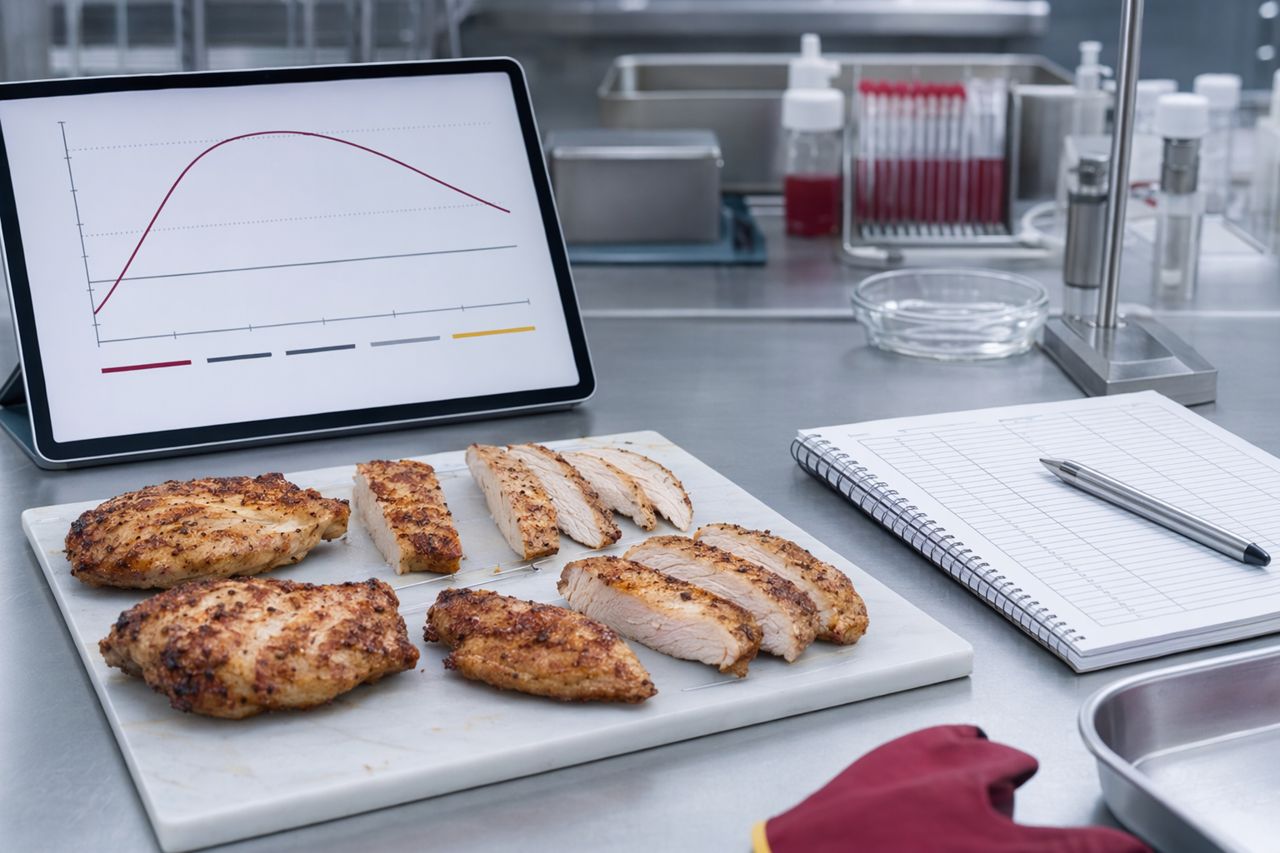
- Sensory and texture review to confirm the eating quality target is met without negative texture drift.
- Scale-up confirmation across real raw material variation, batch size, hold time, and packaging format.
The sensory panel sits between technical measurement and plant decision-making. It helps answer the questions that instruments alone do not fully resolve:
- Does the product bite cleanly?
- Is tenderness improved without becoming mushy?
- Is juiciness maintained after cook and hold?
- Does the marinade profile remain balanced?
- Is texture repeatable across pieces and batches?
Start With a Clear Tenderness Target
Before running a panel, define the product outcome in plant language.
Recommended trial target statement
Use a concise statement like this:
The marinated chicken breast should show a measurable improvement in bite tenderness versus the current control, while maintaining intact muscle texture, clean sliceability, typical juiciness, and no off-flavor associated with processing.
This target prevents the trial from rewarding tenderness alone. In enzyme-assisted systems, the best result is controlled tenderness, not maximum softening.
Trial Design: Keep the Plant Variables Tight
Sensory data becomes weak when process variables drift. For tenderness trials, control the following before the panel begins.
Raw material controls
- Use the same cut, supplier stream, size band, and chill condition where possible.
- Record harvest age or raw material class if available.
- Avoid mixing extremes in thickness or initial texture within one coded sample set.
Marinade and process controls
- Hold brine composition constant except for the enzyme tenderizing variable being tested.
- Use the same injection pressure, pickup target, tumble profile, dwell time, and cook schedule.
- Track actual pickup, post-tumble appearance, purge, cook yield, and finished temperature.
- Keep sample handling consistent from chilling through reheating or serving.
Comparison cells
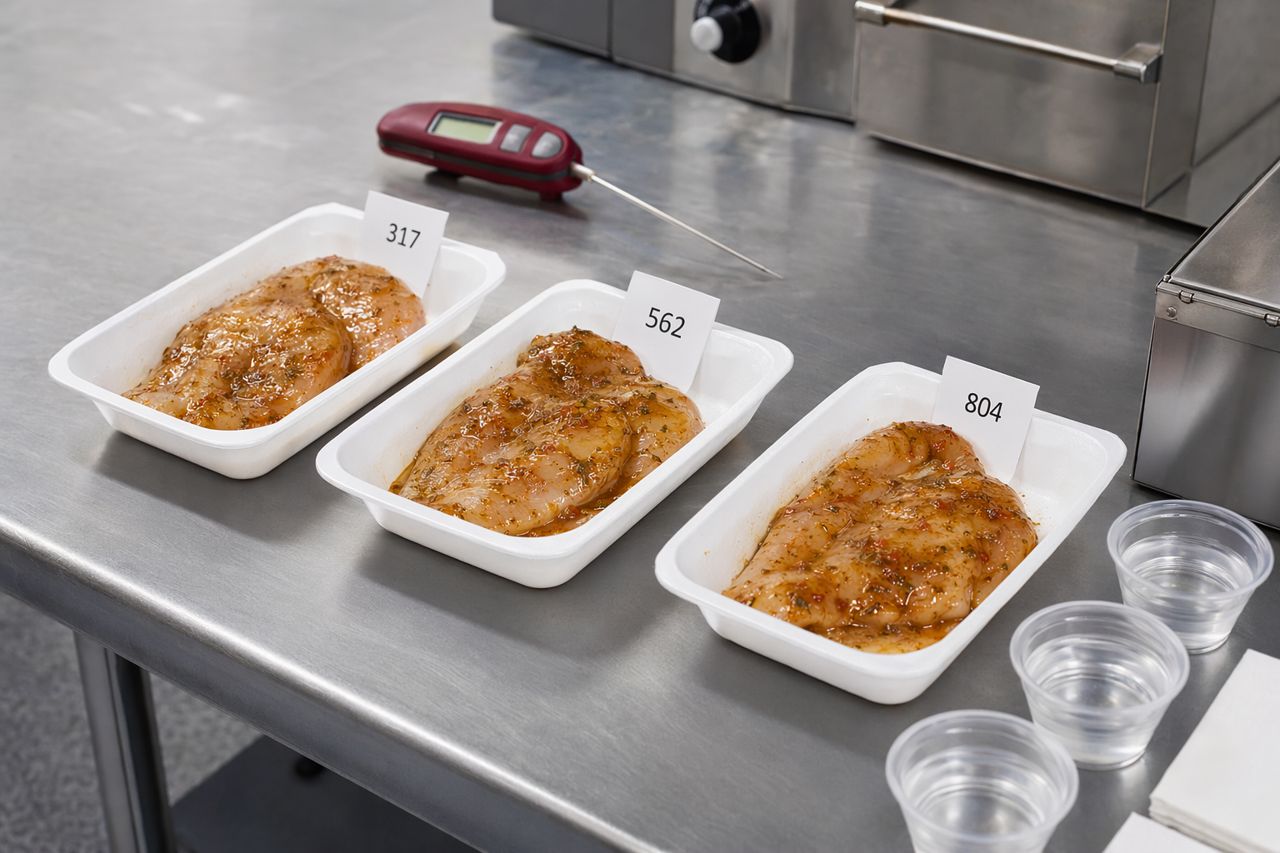
For a simple first validation panel, use three to four coded samples:
| Cell |
Purpose |
Example |
| A |
Current process control |
Existing marinade, no enzyme tenderizing change |
| B |
Low intervention concept |
Conservative enzyme tenderizing condition |
| C |
Target concept |
Proposed enzyme tenderizing condition |
| D |
Stress condition, optional |
Higher exposure or longer dwell to identify over-tenderizing risk |
Do not overload the first panel. Too many samples can fatigue panelists and blur tenderness discrimination.
Panel Format for a Poultry Plant
A good internal sensory panel does not need to feel academic. It needs discipline, repeatability, and clear scoring.
Recommended panel structure
- Panel size: 8 to 12 trained internal panelists for development screening.
- Panelists: R&D, QA, culinary, and selected production or technical team members.
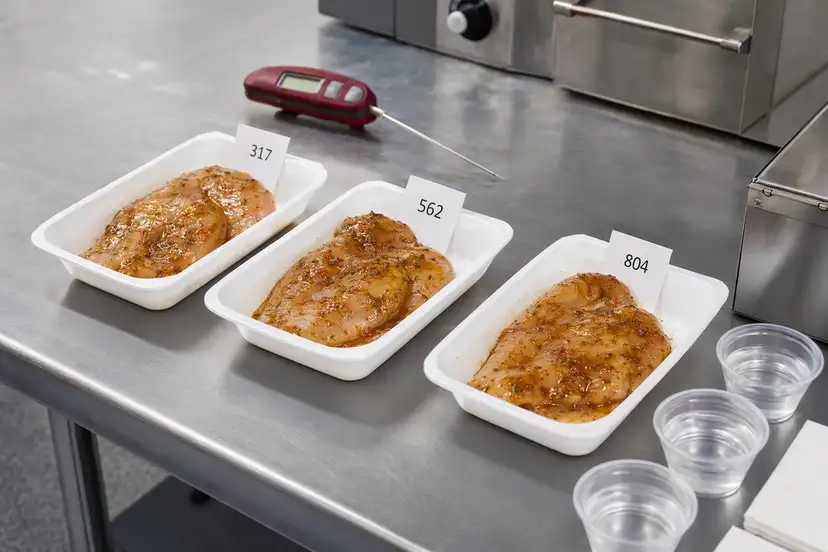
- Coding: Use random three-digit sample codes.
- Serving order: Randomize order across panelists.
- Serving condition: Standardize temperature, piece size, cut orientation, and hold time.
- Palate reset: Provide water and plain crackers or another neutral reset.
- Discussion: Collect individual ballots before group discussion.
The most important rule: panelists score what they perceive before hearing what others think.
Sensory Panel Template
Use a 1 to 9 intensity scale for each attribute. Keep the anchors simple and visible.
| Attribute |
1 Anchor |
5 Anchor |
9 Anchor |
Why It Matters |
| Initial bite tenderness |
Very tough |
Acceptable bite |
Extremely tender |
Primary performance target |
| Chew-down tenderness |
Fibrous, resistant |
Moderate breakdown |
Very easy breakdown |
Detects persistent toughness or over-softening |
| Muscle integrity |
Falls apart or pasty |
Mostly intact |
Firm, intact fibers |
Protects against mushy texture |
| Juiciness |
Dry |
Typical |
Very juicy |
Confirms tenderness is not achieved at the expense of eating quality |
| Sliceability |
Ragged or fragile |
Acceptable |
Clean, stable slice |
Important for deli, strips, diced, and prepared formats |
| Marinade flavor balance |
Unbalanced |
Typical |
Very balanced |
Ensures process change does not distort flavor perception |
| Off-note perception |
Strong off-note |
Slight or none |
None detected |
Screens for unintended sensory impact |
| Overall acceptability |
Poor |
Commercially acceptable |
Excellent |
Summarizes buying and specification relevance |
Add a forced-choice question
After scoring, ask one direct question:
Which sample best meets the target for controlled tenderness and plant-ready texture?
This helps identify the practical winner when numerical scores are close.
Sample Ballot Copy
Use this as a starting point for an internal trial sheet.
Product
Marinated chicken breast tenderness validation
Serving condition
Cooked and served according to trial protocol. Evaluate each coded sample independently.
Instructions for panelists
- Taste samples in the order provided.
- Score each attribute from 1 to 9 using the anchors shown.
- Do not discuss samples until all ballots are submitted.
- Note any texture words that stand out, especially tough, clean bite, juicy, fibrous, soft, mushy, pasty, or fragile.
Ballot fields
| Coded Sample |
Initial Bite |
Chew-Down |
Muscle Integrity |
Juiciness |
Sliceability |
Flavor Balance |
Off-Note |
Overall Acceptability |
Comments |
| ___ |
|
|
|
|
|
|
|
|
|
| ___ |
|
|
|
|
|
|
|
|
|
| ___ |
|
|
|
|
|
|
|
|
|
| ___ |
|
|
|
|
|
|
|
|
|
Final selection
Best match to target: ___
Reason: ___
How to Interpret the Results
Do not rely on average tenderness alone. Averages can hide texture risk.
Look for three signals
-
Target movement
The preferred treatment should improve initial bite and chew-down tenderness versus the control.
-
Texture guardrails
Muscle integrity and sliceability should remain within the acceptable range. A sample that scores high on tenderness but low on integrity is not ready for scale-up.
-
Panel agreement
Review score spread and comments. If half the panel writes clean bite and the other half writes mushy, the process window may be too narrow.
Practical pass criteria
A treatment is a good candidate for the next trial if it:
- Improves tenderness against the current control.
- Maintains intact muscle texture.
- Avoids pasty or fragile bite descriptors.
- Keeps juiciness and flavor balance commercially acceptable.
- Performs consistently across pieces in the same batch.
- Fits the plant dwell time, throughput, and label expectations.
Common Failure Modes in Tenderness Panels
Over-tenderizing
Symptoms include pasty bite, weak muscle structure, excessive fragility, poor slicing, and comments such as soft in a bad way. This usually indicates that the formulation or exposure condition needs tightening.
Under-differentiation
If panelists cannot separate the control from the treatment, the process may be too conservative, the raw material variation may be too wide, or the serving method may be masking differences.
Process noise
Uneven injection, inconsistent pickup, variable dwell time, or inconsistent cook temperature can create false sensory results. Fix the process noise before changing the formulation.
Flavor distraction
Strong spice, smoke, acid, sweetness, or salt changes can mask tenderness perception. Keep flavor changes out of the first tenderness validation whenever possible.
Label and Commercial Considerations
Tenderness trials should be aligned with label, customer, and channel requirements early. For many further-processing teams, the winning process must satisfy more than sensory performance.
Consider:
- Ingredient declaration strategy.
- Customer expectations for clean, familiar, or functional labels.
- Compatibility with phosphate, salt, starch, hydrocolloid, or flavor systems.
- Frozen, chilled, sous-vide, fully cooked, or ready-to-cook formats.
- Hold time before cook and distribution conditions after pack.
A technically strong enzyme tenderizing condition still needs to fit the plant’s commercial format.
Embedded Explainer Video
This page includes a short faceless explainer video showing how to structure a marinated chicken tenderness panel from coded samples to scale-up decision. The visual system uses macro muscle-fiber contours, calibrated marinade movement, stainless process equipment, and a tenderness curve resolving into a defined target.
How FibreYield Supports Tenderness Trials
FibreYield works with poultry further-processing teams on practical enzyme tenderizing programs for marinated chicken. Support can include:
- Application guidance for tenderizing concepts.
- Trial design for control, target, and stress-condition comparisons.
- Process-fit review for injection, tumbling, dwell time, cook, chill, and pack.
- Sensory panel templates and interpretation support.
- Scale-up planning for repeatability across batch size and raw material variation.
The goal is not simply a softer chicken product. The goal is controlled tenderness that survives real plant conditions.
Request a Quote
If you are developing a marinated chicken tenderness trial, FibreYield can help define the process path, sample plan, and scale-up requirements.
Request a quote through the on-site contact form and include your product format, current process, target texture, and planned trial timing.